

POLAR H10 Gold standard of heart rate monitor for India
Polar H10 Heart Rate Monitor: Why It's the Gold Standard in 2026
Ask any coach, sports scientist, or serious athlete which device they trust when the numbers actually matter, and one name comes up again and again: the Polar H10 heart rate monitor. It has become the reference point that every other tracker gets measured against — the device researchers strap on when they need lab-grade data without a lab. In this guide we break down exactly why the Polar H10 earns its "gold standard" reputation, how it compares to wrist-based trackers, and who should be wearing one.
Shop the Polar H10 at WOD Armour →What Makes a Heart Rate Monitor the "Gold Standard"?
The phrase gets thrown around a lot, but in sports science it means something specific: a device whose readings are trusted enough to validate other devices. When a wearables company wants to prove its new watch is accurate, it publishes a study comparing that watch against a medical ECG — and against a chest strap like the Polar H10.
To reach that status, a monitor has to deliver three things consistently: true beat-to-beat measurement of the heart's electrical signal, reliability across every type of training from sprints to heavy squats, and rock-solid connectivity that doesn't drop out mid-session. The Polar H10 is one of the very few consumer devices that checks all three boxes, which is why it keeps showing up in peer-reviewed research and elite training rooms alike.
ECG Accuracy: The Science Behind the H10
Your heart generates a small electrical impulse every time it beats. The Polar H10 measures that electrical activity directly through electrodes woven into the chest strap — the same fundamental principle a clinical electrocardiogram (ECG) uses. This is a completely different approach from the green LED lights on a smartwatch, which shine into your skin and estimate your pulse from changes in blood flow (a method called optical or PPG sensing).
Measuring the electrical signal at the source is why the H10 is so hard to beat. Polar tested the H10 against medical-grade reference equipment and reported heart-rate detection accuracy of 99.3% for cycling, 95.6% across all activities combined, 95.3% for weight training, and 92.9% for running — all within a 2-millisecond window. For anyone doing interval work, threshold runs, or heart-rate-zone training, that precision is the difference between hitting your target zone and guessing.
Polar H10 Specifications at a Glance
| Feature | Detail |
|---|---|
| Sensor type | ECG (electrical) chest sensor |
| Connectivity | Bluetooth, ANT+ and 5 kHz analog |
| Simultaneous connections | Two Bluetooth devices + ANT+ at the same time |
| Battery | Replaceable CR2025 coin cell, ~400 hours of use |
| Internal memory | Stores one training session strap-free |
| Waterproofing | Fully waterproof — suitable for swimming |
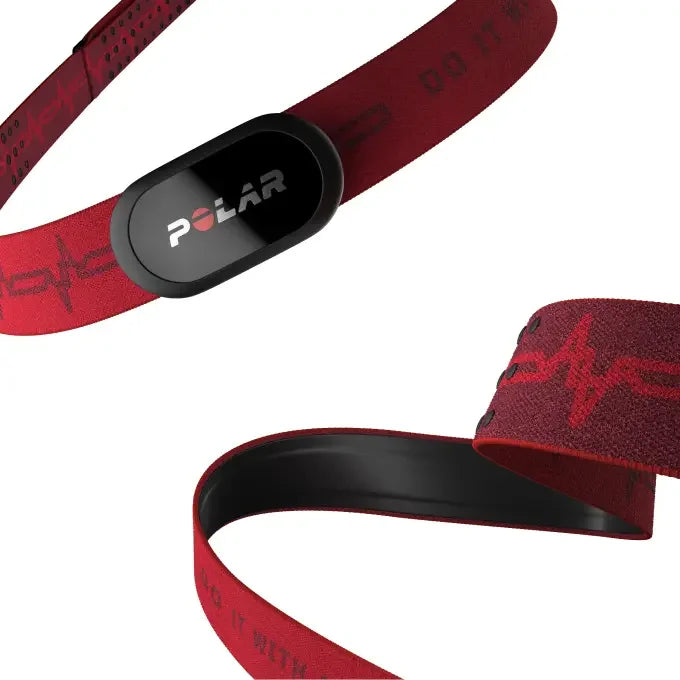
| Strap | Polar Pro strap with silicone grip dots and easy buckle |
A few of these deserve a closer look. The 400-hour battery means most athletes train for a full year or more before swapping the coin cell — and because it's user-replaceable, there's no charging cable to remember before a race. The internal memory lets you leave your phone and watch behind: start a session, train, and sync afterward. And because the strap is genuinely waterproof, it works in the pool where optical watches often fail entirely.
Check Polar H10 availability & pricing →Chest Strap vs. Wrist Tracker: An Honest Comparison
Wrist trackers are fantastic all-day companions — they count steps, track sleep, and never leave your arm. But they were built for convenience, not laboratory precision. The Polar H10 was built for the opposite priority. Here's how the two stack up where it counts.
Where the chest strap wins
During high-intensity intervals, heavy resistance training, and anything involving sudden changes in effort, the H10's electrical reading responds instantly while optical sensors smooth and lag. Wrist tension, tattoos, cold skin, and a loose band all degrade optical accuracy — none of which affect a properly moistened chest strap.
Where wrist trackers are fine
For steady-state cardio, general wellness, and everyday step counting, a modern optical watch is perfectly adequate. The point isn't that wrist sensors are bad — it's that when accuracy is non-negotiable, the H10 is the tool the professionals reach for. Many athletes actually wear both: the watch for daily life, the H10 paired to it for real workouts.
Connectivity: Bluetooth, ANT+ and 5 kHz
Accuracy is only useful if the data reaches your screen. The Polar H10 broadcasts on Bluetooth, ANT+, and a 5 kHz analog signal simultaneously, which makes it one of the most universally compatible sensors on the market. You can pair it to two Bluetooth devices and an ANT+ device at once — for example, feeding your bike computer, your training app, and a gym display all at the same time.
That triple-protocol support means the H10 works with virtually everything: Peloton, Zwift, Wahoo, Garmin, Strava, Polar Flow, gym cardio machines, and countless third-party apps. Buy it once and it slots into whatever training ecosystem you already use — and whatever you migrate to next.
Who Should Use the Polar H10?
The H10 is the right choice for anyone whose training decisions depend on the number. That includes runners and cyclists doing structured zone or threshold work, CrossFit and functional-fitness athletes who need accuracy through explosive movement, triathletes who need one strap that works in the pool and on the bike, and coaches or researchers collecting data they can actually stand behind.
If you only want a rough daily calorie estimate, a wrist tracker is enough. But if you've ever doubted whether your watch was really showing your effort, the H10 removes that doubt for good.
Getting the Most From Your Polar H10
A chest strap rewards a little care. Moisten the electrode area before each session — dry electrodes are the number-one cause of erratic early readings. Position the strap just below the chest muscles, snug but not restrictive. Rinse the strap after sweaty or salty sessions and detach the sensor pod before machine-washing the strap periodically. Do that, and the H10 will deliver consistent, dependable data for years.
Frequently Asked Questions
Is the Polar H10 really more accurate than a smartwatch?
Yes. The H10 measures the heart's electrical signal directly (ECG), while smartwatches estimate heart rate optically through the skin. During high-intensity and resistance training especially, the electrical method is significantly more reliable, which is why it's used to validate other devices in research.
How long does the Polar H10 battery last?
Roughly 400 hours of use on a single CR2025 coin cell. The battery is user-replaceable, so there's no charging cable and no risk of a dead device before a big session.
Can I use the Polar H10 for swimming?
Yes. The strap is fully waterproof and stores a session in its internal memory, so you can train phone-free in the pool and sync the data afterward.
Does the Polar H10 work with my apps and devices?
Almost certainly. It broadcasts on Bluetooth, ANT+, and 5 kHz simultaneously, making it compatible with Zwift, Peloton, Garmin, Wahoo, Strava, Polar Flow, gym equipment, and most fitness apps — several at the same time.
Where can I buy the Polar H10?
You can buy the Polar H10 directly from the WOD Armour Polar H10 product page, with sizing options and fast shipping.
The Verdict
Years after its release, the Polar H10 remains the benchmark other heart rate monitors are judged against — and nothing in the consumer market has knocked it off that pedestal. ECG-grade accuracy, universal connectivity, a year-plus battery, and true waterproofing add up to a device that simply tells you the truth about your effort. If you train with intent, it's the last heart rate monitor you'll need to buy.
Get your Polar H10 from WOD Armour today →

1 comment
I need portable hrv equipment polar H10 with software for research purpose